If you've lived in a Manhattan apartment for more than a year, you've already accepted the bargain.
Maybe your building has a laundry room — and "has" is generous. It's in the basement, it has three machines for a forty-unit building, two of them break weekly, and the card system charges you four dollars to wash a single load that fits in a cat carrier. The dryer has settings — you've never figured out which one means dry. You go down at 7am on a Sunday because that's the only window with a real chance of an open machine, and you sit on the cold tile in your bathrobe scrolling your phone for forty minutes because if you leave, someone will move your wet clothes to the floor and start their own load.
Or maybe your building doesn't even have that. Maybe you live in a fifth-floor walk-up on Avenue B in a building that was finished in 1908 and renovated in 1962 and has not had a structural laundry conversation since. Your option is the corner laundromat, which means hauling a thirty-pound bag down five flights, walking three blocks, sitting on a plastic chair under fluorescent light for ninety minutes, and hauling a thirty-pound bag of wet-then-folded clothes back up five flights. You do this every two weeks. You do this in February. You do this when you're already exhausted from work.
Or maybe you have an in-unit washer-dryer — congratulations, you've solved the housing crisis, this article isn't for you.
For the rest of us, laundry in Manhattan is a structural problem that most New Yorkers stop noticing because there's no obvious solution. You make peace with it. You call it "part of living in New York." You absorb the time cost into the general cost of being here.
We built Suds Buds to be the obvious solution.
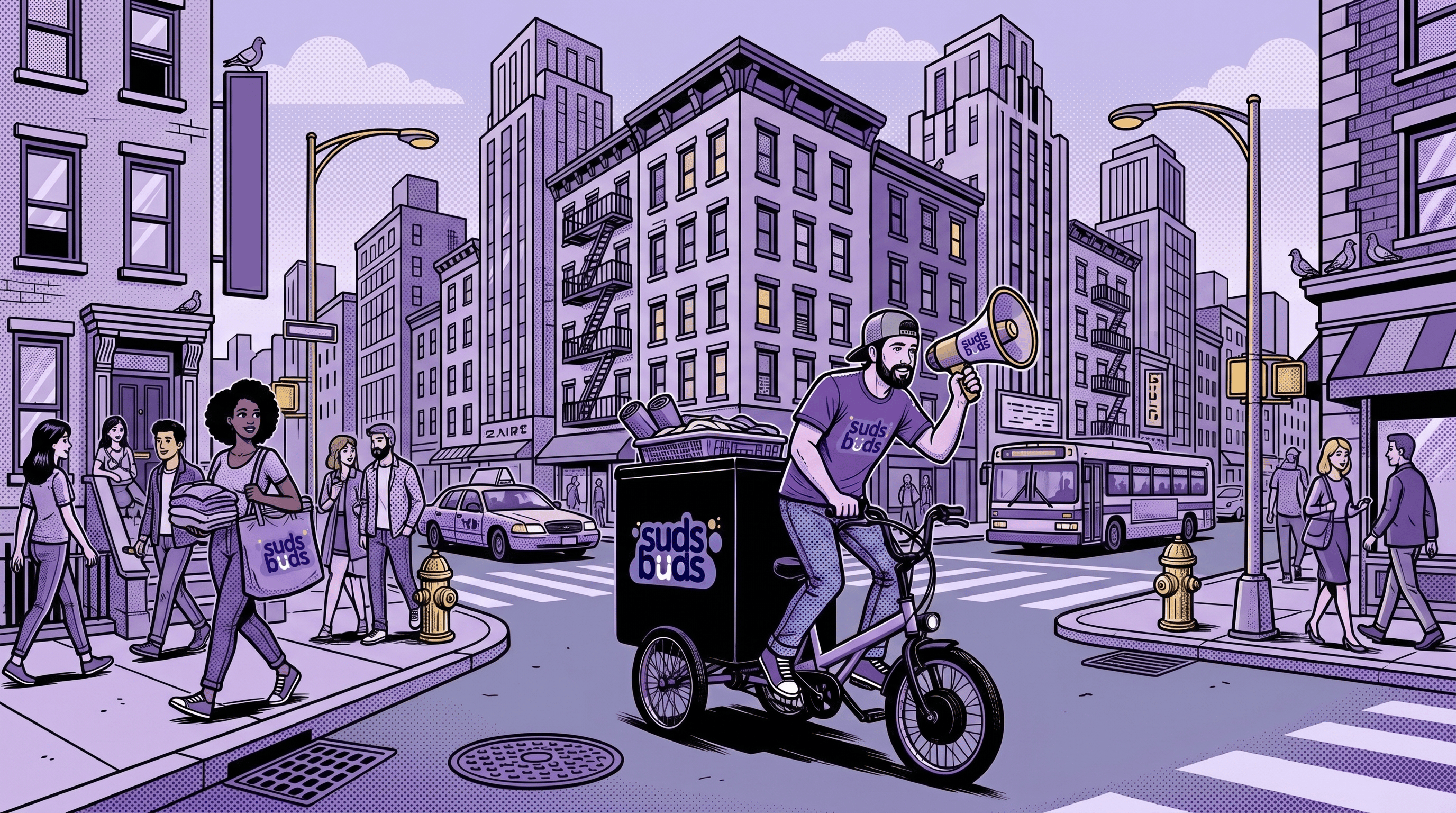
Here's what that means in practice. We're at 540 East 14th Street. We have an e-trike. Our driver picks up your laundry at your apartment door — fifth floor walk-up, doorman building, basement service entrance, whatever your building's setup is. We bring it back to our shop on 14th, hand-fold it (every shirt, every sock, every dish towel, the way you'd fold it if you had three free hours), and bring it back to your door same-day or next-day. Free. No minimum delivery fee. No trip charge. No "premium membership" required to unlock the basic service everyone should have.
Twelve neighborhoods are on our route — Stuy Town, East Village, Alphabet City, the Lower East Side, Greenwich Village, NoHo, SoHo, Gramercy Park, Murray Hill, Kips Bay, the NYU area, Union Square. If you live in any of those, our e-trike runs your block daily.
The economics are simple. Per-pound wash & fold, two pricing tracks — next-day or same-day — with a fifteen-pound minimum. A typical apartment-dweller's two-week pile runs about twenty-two to thirty pounds. Most of our customers stop doing their own laundry within two weeks of starting. Current rates at sudsbuds.com/pricing.
Some of you will read this and think: I can't justify spending money on something I can technically do myself.
That's a real argument and we're not going to win it on cost-per-pound. But it's the wrong frame. The question isn't "is this cheaper than my own laundry." The question is: how much is the four hours of your Sunday worth, plus the elevator-room negotiation, plus the loading and unloading, plus the cold-tile waiting? For a lot of New Yorkers, the math works the other direction the first time they actually run it.
If you want to try it, schedule a pickup at sudsbuds.com/schedule. First order is twenty percent off.
If you don't, that's fine too. The laundromat is here when you change your mind.